

 coming soon!
 Contact Us
Stepper Motors
Built for Accuracy, High Torque & Reliable Movement
Our Stepper Motors offer exceptional precision and control for your demanding positioning applications. These high-performance motors are 100 % made in Europe, ensuring long-lasting reliability.
- Accurate Movement: Our 2-phase hybrid stepper motors provide a precise 1.8° step angle, ideal for microstepping up to 204800 steps per revolution.
- Configurable Power: Choose from 3 NEMA sizes to match your project's torque and speed requirements. Ideal for high torque applications.
- Enhanced Functionality: Optionally equip your motors with planetary gearboxes for increased torque or encoders for real-time position feedback and breaks for safety reasons.
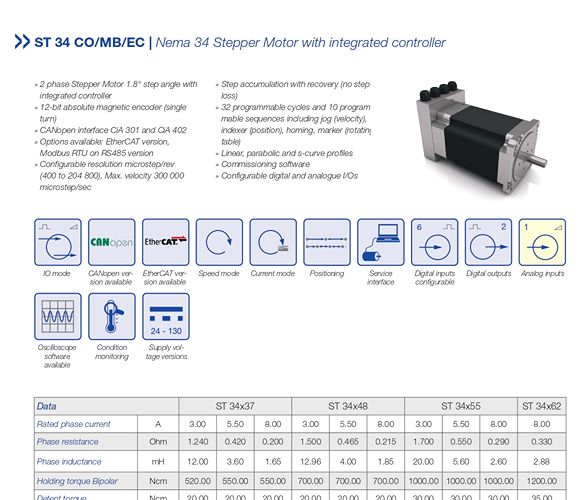
- Integrated Control Option: Select motors with integrated controllers for a simplified, all-in-one solution.
Product Datasheets

Customization and Support
- Tailored Stepper Motor Solutions: Our expert technical team specializes in customizing stepper motors to meet your unique requirements. We offer modifications to the shaft, cable, connector, and IP protection, ensuring that each motor fits perfectly into your application.
- Fitting Gearboxes for All Sizes: We provide high-quality planetary gearboxes designed to fit all Nema stepper motor sizes, ensuring optimal compatibility and performance. Also for security reasons a perfect matched power off break. To keep you application in place when power is off.
- Integrated Electronics: Enhance your stepper motors with our integrated electronic solutions, providing seamless control and improved performance.
- Comprehensive Controller Options: Choose from a wide range of controllers, including low-cost Step & Direction RS485 controllers and high-end Closed Loop Controllers with Industrial Ethernet interface and Can Open.


Get a free consultation to discuss your specific needs and find the best solution for your application.
-
Product Datasheet
-
FAQ's




-
What is a stepper motor ?A stepper motor, also known as step motor or stepping motor, is a brushless DC electric motor that divides a full rotation into a number of equal steps. The motor's position can be commanded to move and hold at one of these steps without any position sensor for feedback (an open-loop controller), as long as the motor is correctly sized to the application in respect to torque and speed.
-
Which are the main performance parameters in a stepper motor ?Stepper motors have different torque-speed characteristics depending on whether the motor is starting/stopping or already running. But a stepper motor can also produce torque when it is not moving, and these stationary torque values — referred to as holding torque and detent torque — are also important factors to consider when sizing and selecting a stepper motor. One of the beneficial features of a stepper motor is its ability to hold a load in place when the motor coils are energized, due to the attraction between the rotor and stator. This is referred to as the motor’s holding torque and is the torque required to move the motor one full step when the coils are energized but the rotor is stationary. A stepper motor’s holding torque is higher than its running torque and is limited primarily by the amount of current the motor can withstand. Detent torque occurs when the motor is not energized — that is, no current is flowing through the motor windings. It occurs because of the attractive forces between the magnets in the motor’s rotor and the stator.
-
Which modular systems are available in stepper motors ?MAE stepper motors can be combined with a wide range of planetary gearboxes design, encoders and integrated controllers with CANopen, Ethercat or Modbus RTU interfaces.
-
Are MAE products UL approved ?In some cases, the North American market requires UL or CSA approved solutions. With a few exceptions, we use UL listed materials. Ask Your Sales contact if your products can be UL or CSA approved.
-
Do MAE products have CE certification ?In general, MAE products are classified as components, a device which is not intended to work standalone, but needs to be incorporated into a system by electrical and mechanical provisions in order to function as intended and safely; as such, they do not require the CE marking. Ask our sales department for details.
Where Our Stepper Motors Are Used
Our stepper motors are versatile and reliable, making them ideal for a wide range of applications across various industries. Here are some examples of where and how our stepper motors are utilized:
3D Printers
Stepper motors are essential in 3D printers for their precise control over movement. They enable accurate positioning of the print head and build platform, ensuring high-quality prints. The 1.8° step angle of our motors provides an easy option to control or use microstepping up to 204,800 microsteps per revolution, bringing really fine resolution needed for detailed and complex designs.
CNC Machines
In CNC (Computer Numerical Control) machines, stepper motors drive the movement of cutting tools with high precision. This allows for the creation of intricate parts and components in manufacturing. The high torque and reliability of our stepper motors make them ideal for maintaining accuracy and repeatability in CNC operations.
Robotics
Robotic systems often rely on stepper motors for precise control of joints and movements. Our motors' ability to provide consistent torque and accurate positioning helps in tasks ranging from simple pick-and-place operations to complex robotic surgery. The modular design allows for easy integration with various robotic components.
Medical Devices
Stepper motors are used in medical devices such as infusion pumps and imaging equipment. Their precise control ensures accurate dosing and positioning, which is critical for patient safety and effective treatment. Our motors' compact design and customizable features make them suitable for the stringent requirements of the medical industry.
Textile Machinery
Textile machinery uses stepper motors to control the movement of threads and fabrics during weaving and knitting processes. The precise control offered by our motors ensures uniformity and quality in textile production. The ability to customize motor features allows for adaptation to various textile applications.
Home Automation Systems
Stepper motors are integral to home automation systems, controlling devices such as automated blinds, smart locks, and security cameras. Their precise movement and reliability ensure smooth operation and enhanced security. Our stepper motors' customizable features allow for seamless integration into various smart home devices.
home automation systems, printing equipment, packaging machinery, the automotive industry, laboratory equipment, vending machines, and solar tracking systems.
How to Select the Right Stepper Motor for Your Application
Choosing the right stepper motor for your application involves considering several key factors to ensure optimal performance and efficiency. Here’s a guide to help you make the best choice:
1. Determine the Load Requirements
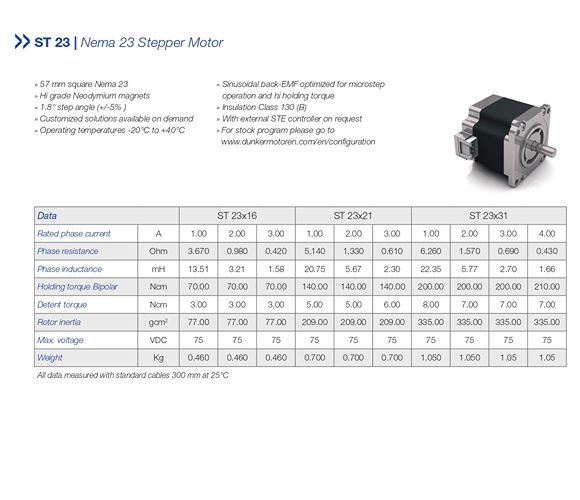
- Torque: Identify the torque requirements of your application. Consider both the holding torque (static) and the pull out torque (dynamic). Our stepper motors offer holding torques up to 12 Nm, suitable for various applications.
- Speed: Determine the speed at which the motor needs to operate. Stepper motors are ideal for applications requiring precise control at low to moderate speeds.
- Combination: The most important point is the combination of speed and torque. Define your operating point or points and look at the motor curve. If your point is below the curve, it will work.
2. Select the Appropriate Size
- Nema Sizes: Choose the appropriate Nema size (17, 23 or 34) based on your space constraints and torque requirements. Larger Nema sizes generally provide higher torque but less dynamik and speed.
- Compact Design: Ensure the motor fits within the physical dimensions of your application. Our stepper motors are designed to offer high torque in a compact form factor.
3. Consider the Step Angle
- Resolution: The step angle determines the resolution of the motor. A common step angle is 1.8°, which provides 200 steps per revolution. For higher precision, consider motors with smaller step angles or microstepping capabilities.
4. Evaluate the Environmental Conditions
- Temperature: Ensure the motor can operate within the temperature range of your application. Consider any additional cooling requirements.
- Protection: Assess the need for IP protection against dust and moisture. Our stepper motors can be customized with various IP ratings to suit different environments.
5. Integration with Gearboxes and Encoders
- Gearboxes: Determine if your application requires additional torque or speed reduction. Our stepper motors can be paired with special planetary gearbox for enhanced performance.
- Encoders: For applications requiring precise feedback, consider integrating high-resolution encoders.
6. Control and Drive Requirements
- Controllers: Choose the appropriate controller based on your control needs. We offer a range of controllers, from low-cost Step & Direction RS485 controllers to high-end Closed Loop Controllers with Industrial Ethernet /CanOpen interface and Safe Torque Off functionality.
- Power Supply: Ensure the motor and controller are compatible with your power supply specifications. Different windings for different currents allow you to use the same motor with different voltages.
7. Customization Options
- Tailored Solutions: Consider any specific customization needs, such as shaft modifications, cable lengths, connectors, or additional features. Our technical team can provide tailored solutions to meet your exact requirements.
8. Consult with Experts
- Free Consultation: Take advantage of our free consultation service to discuss your specific needs with our experts. They can help you select the right stepper motor and configure it for your application.
Benefits of Stepper Motors
1. Precise Positioning and Control
Stepper motors excel in providing accurate positioning and control, making them ideal for applications where precision is crucial. They move in discrete steps or really precise microstepping, allowing for exact control over rotation and movement.
2. High Torque at Low Speeds
Unlike traditional motors, stepper motors provide high torque even at low speeds. This provides full torque without a gearbox over the entire speed range of the stepper motor.
3. Reliability and Durability
Stepper motors are highly reliable due to their simple design with no contact brushes, minimizing mechanical failure and maximizing operational lifespan.
4. Cost-Effectiveness
Stepper motors are generally more affordable than other types of motors, such as servo motors, making them a cost-effective solution for many applications
5. Flexibility in Control
They offer excellent speed control and can be easily integrated with various control systems, providing flexibility in different applications.
Stepper Motors: Understanding NEMA Sizes
NEMA (National Electrical Manufacturers Association) sizes refer to the standardized dimensions of stepper motors.
These sizes help ensure compatibility and interchangeability across different applications. Here's a breakdown of the NEMA sizes we offer:
NEMA 17
- Dimensions: 42 x 42 mm
- Applications: Ideal for 3D printers, small CNC machines, and robotics.
- Features: Compact size with high torque, suitable for precise control in limited spaces, also speeds 2000 rpm possible.
NEMA 23
- Dimensions: 57 x 57 mm
- Applications: Commonly used in CNC machines, larger 3D printers, and industrial automation.
- Features: Offers a balance between size and torque, making it versatile for various applications.
NEMA 34
- Dimensions: 86 x 86 mm
- Applications: Suitable for heavy-duty CNC machines, packaging machinery, and conveyor systems.
- Features: Provides higher torque for demanding applications, ensuring reliable performance.
Compare NEMA Sizes
| NEMA Size | Dimensions (mm) | Typical Applications | Key Features |
|---|---|---|---|
| NEMA 17 | 42 x 42 | 3D printers, small CNC machines, robotics | Compact, high torque |
| NEMA 23 | 57 x 57 | CNC machines, larger 3D printers, industrial automation | Versatile, balanced size and torque |
| NEMA 34 | 86 x 86 | Heavy-duty CNC machines, packaging machinery, conveyor systems | High torque, reliable performance |
| NEMA 42 | 110 x 110 | Large industrial machines, automation systems | Maximum torque, robust performance |
Stepper Motors vs. Other Motor Types
When selecting a motor for your application, it's important to understand the differences between stepper motors and other common motor types, such as servo motors and DC motors. Here's a detailed comparison to help you make an informed decision:Stepper Motors
Advantages:
- Precise Positioning and Control: Stepper motors move in discrete steps, allowing for accurate control over position and speed. This makes them ideal for applications requiring precise movements, such as 3D printers and CNC machines.
- High Torque at Low Speeds: Stepper motors provide high torque even at low speeds, ensuring smooth and controlled movements.
- Cost-Effective: Generally more affordable than servo motors, making them a cost-effective solution for many applications.
- Simplicity: Easy to control without the need for complex feedback systems, reducing the overall system complexity.
- Reliability: With fewer moving parts and no brushes, stepper motors are highly reliable and have a longer operational life.
Disadvantages:
- Limited Speed: Stepper motors are not suitable for high-speed applications as their torque decreases with increasing speed.
- Overload possibility: : For acceleration and deceleration, the stepper motor can provide an overload capacity.
Servo Motors
Advantages:
- High Speed and Torque: Servo motors can achieve high speeds and provide high torque, making them suitable for dynamic applications.
- Closed-Loop Control: Equipped with feedback systems, servo motors offer precise control over position, speed, and torque.
- Smooth Operation: Servo motors provide smooth and continuous motion, ideal for applications requiring high precision and dynamic performance.
Disadvantages:
- Complexity: Servo motors require complex control systems and feedback mechanisms, increasing the overall system complexity.
- Cost: Generally more expensive than stepper motors, making them less cost-effective for some applications.
DC Motors
Advantages:
- Simple Control: DC motors are easy to control with simple voltage adjustments, making them suitable for basic applications.
- High Speed: Capable of achieving high speeds, DC motors are ideal for applications requiring rapid movement.
- Cost-Effective: Generally more affordable than servo motors, providing a cost-effective solution for many applications.
Disadvantages:
- Less Precise: DC motors do not offer the same level of precision as stepper or servo motors, making them less suitable for applications requiring accurate positioning.
- Lower Torque at Low Speeds: DC motors provide lower torque at low speeds, which can be a limitation for certain applications.
- Brush Wear: DC motors with brushes require regular maintenance to replace worn brushes, reducing their operational life.
Compare Motor Types
| Motor Type | Advantages | Disadvantages | Typical Applications |
|---|---|---|---|
| Stepper Motors |
|
|
|
| Servo Motors |
|
|
|
| DC Motors |
|
|
|