

 coming soon!
 Contact Us
Brushless Motors
Brushless DC motors (also BLDC motor or EC motor) - low-wear, maintenance-free, high efficiency and robust. AC or DC operation with integrated electronics possible. BLDC motors are available with gearboxes, brakes and encoders.


Any questions on this product? Please feel free to contact us!
CONTACT US

Configure suitable gearboxes and download 3D models
CONFIGURATOR


Adjustable
- Custom windings for applications
- AC and DC supply voltage options
- Shaft and mounting bracket customization
- UL approval

Compact and Efficient
- High efficiency
- Long operating life

Modular
Various combinations of brakes, motors, gearboxes, encoders and controller…

Competence
- 60 Years of drive experienced
- High competence in application support
Specifications
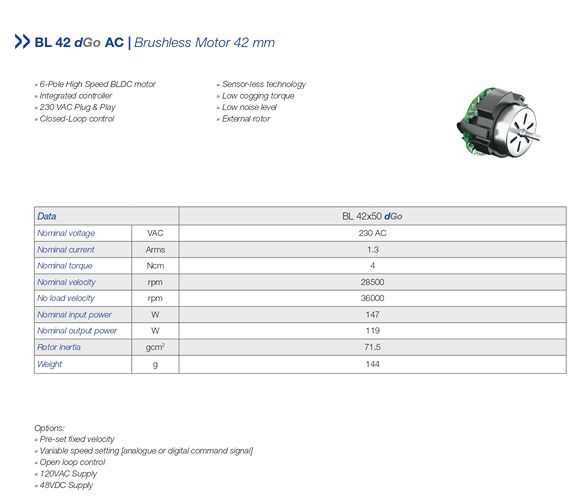
| Motor Length | x50 - x111 | mm |
|---|---|---|
| Rated Output Power | 46 - 230 | W |
| Rated Voltage | 24 / 40 DC, 110 / 230 AC | V |
| Rated Torque | 4, 65, 11 - 35 | Ncm |


-
Product Datasheet
-
FAQ's


-
Which motor technologies are available at MAE ?From Universal Series and Brushed DC to Stepper and Brushless DC. Using these motor technologies, we then develop modular solutions to address customer needs in torque application (drives) or air movement application (blowers).
-
What is a Universal motor ?The universal motor is a type of electric motor that can operate on either AC or DC power and uses an electromagnet as its stator to create its magnetic field. It is a commutated series-wound motor where the stator's field coils are connected in series with the rotor windings through a commutator. It is often referred to as an AC series motor. Universal motors have high starting torque, can run at high speed, and are lightweight and compact. They're also relatively easy to control, electromechanically using tapped coils, or electronically. However, the commutator has brushes that wear, so they are much less often used for equipment that is in continuous use.
-
What is Brushless DC motor ?A brushless DC electric motor (BLDC), also known as an electronically commutated motor, is a synchronous motor using a direct current (DC) electric power supply. It uses an electronic controller to switch DC currents to the motor windings producing magnetic fields which effectively rotate in space and which the permanent magnet rotor follows. The controller adjusts the phase and amplitude of the DC current pulses to control the speed and torque of the motor. The construction of a brushless motor system is typically similar to a permanent magnet synchronous motor (PMSM), but can also be a switched reluctance motor, or an induction (asynchronous) motor. They may also use neodymium magnets and be out runners (the stator is surrounded by the rotor), in runners (the rotor is surrounded by the stator), or axial (the rotor and stator are flat and parallel).
-
When to use a Brushless DC motor versus Universal or Brushed DC motors ?Your end application requirements on lifetime, speed and acceleration, efficiency, controllability and cost are the typical factors you need to consider when evaluating these alternate motor technologies.
Lifetime: As previously mentioned, one of the disadvantages of brushed motors is that there is mechanical wear of the brushes and commutator. Carbon brushes in particular are sacrificial, and in many motors they are designed to be replaced periodically as part of a maintenance program. The soft copper of the commutator is also slowly worn away by the brushes, and eventually reach a point where the motor will no longer operate. Since brushless motors have no moving contacts, they do not suffer from this wear.
Speed and Acceleration: Brushed motors rotational speed can be limited by the brushes and commutator, as well as the mass of the rotor. At very high speeds, the brush to commutator contact can become erratic, and brush arcing increases. Most brushed motors also use a core of laminated iron in the rotor, which gives them large rotational inertia. This limits the acceleration and deceleration rates of the motor.
Efficiency: With much lower frictions generated by the control system of brushless motors (no commutator & brushes), their overall efficiency is higher than brushed motors. Frictions are generating heat which essentially represent power losses from the device, taking energy away from the rotor itself, which would be used to drive the load.
Control systems: When speed, torque, or position needs to be controlled, Brushless DC motors are offering much higher control capabilities.
Cost effectiveness: Brushed motor technology has a cost advantage versus the brushless DC. -
Can I order products directly to the manufacturing plant ?No, our business model is based on AMETEK SRL (Italy) being the only possible contractual partner. All orders need to be sent to AMETEK SRL (Italy) while shipping point of the ordered products is based on the manufacturing location.
-
Are MAE products UL approved ?In some cases, the North American market requires UL or CSA approved solutions. With a few exceptions, we use UL listed materials. Ask Your Sales contact if your products can be UL or CSA approved.
-
Do MAE products have CE certification ?In general, MAE products are classified as components, a device which is not intended to work standalone, but needs to be incorporated into a system by electrical and mechanical provisions in order to function as intended and safely; as such, they do not require the CE marking. Ask our sales department for details.